Sarah Huebsch’s article on florid oboe writing in late 18th-century vocal music.
Mozart, Linley, and Obbligato Oboe
‘Piper at the Gates of Dawn’ — Bruce Haynes: Legendary Pioneer of the Hautboy
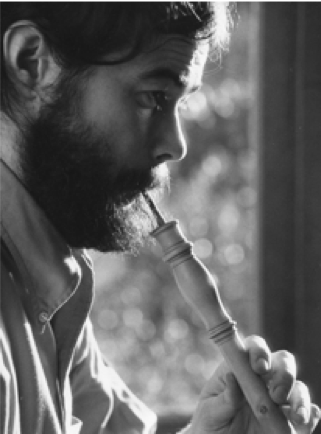 A fabulous tribute article written by Geoffrey Burgess for The Double Reed, with many intriguing details of Bruce’s life and times. A listing of his publications and recordings is also provided. Reposted with the permission of the author.
Boxwood Project in Oxfordshire
An ambitious long-term plan to replenish the supply of boxwood in the Chilterns, Oxfordshire for musical instruments for future generations. Box trees are very slow-growing, often taking more than 100 years to become large enough for a hautboy. Huw is a leading advocate of fairly harvested hardwoods for musical instruments, having also worked in East Africa to preserve and responsibly harvest remaining stands of grenadilla.
For further details please write to Huw at Huwcrompton@aol.com
Review of Bruce Haynes ‘The End of Early Music’
Bruce Haynes (1942-2011) summarized his personal views on rhetorical approaches to music, contrasting them with the romantic and modern styles. A must-read for anyone wanting to understand this topic.
This review by Robert Howe originally appeared in the Journal of the American Musical Instrument Society in 2008.
Description of a staple belonging to an oboe from ca 1720-40
*Description of a staple belonging to an oboe from ca 1720 – 40.*
I found this staple together with an oboe that belongs to the museum ”Kulturen” in Lund, in the south of Sweden. The oboe is stored in their warehouse together with several different objects.
”Kulturen” has two more oboes of interest. One very nice Nuremberg oboe (possibly Oberlender, but has no stamp), ca 1720. I actually found the Nuremberg oboe hanging in a church belonging to the museum, the oboe is now in the warehouse in controlled climate. There is also a Grenser/Wiesner oboe in almost perfect condition. It is still in its original case (no reed case, but the space for the reed case measures 8,4 cm). It has three extra top joints (two of no.1, no.2 and no.3). The extra top joints are not fitted in the case. None of the oboes is on display, but if anyone is interested to see them, please contact me and I can arrange it.
The oboe with the staple (not the Nuremberg one) is in quite bad condition. It is not very nicely done to begin with. The turning is quite rough. It bears marks of some heavy use. Unfortunately, the museum has no idea where they collected the oboe, it has been in their hands for more than a hundred years.
In my imagination, this could have been used as a military instrument, and it has barely survived some of the hard Swedish winters, possibly played on outdoors..
The fingerholes seems very big, possibly made larger to get the oboe to play at a higher pitch. The top joint is also shortened in its lower part. The fingerholes for the left hand is close to the middle joint, and the tenon of the topjoint is too short (did they cut it too much?) for the socket in the middle joint. But the three joints seems to have been made by the same maker and are of the same wood.
One could make a guess that this oboe was used for quite a few years after it was made and delivered. It is most likely that the staple is from the end of this oboe’s lifetime. When that was, one can only speculate..
So the staple does not belong to a perfect instrument, and therefore maybe the staple isn’t the most reliable source either. But still, it might be of interest.
*The oboe.*
Total length: 57,8 cm.
Length from the top to the upper side of the first finger hole: ca 13,7 cm.
From top to the sixth hole: ca 32,3 cm.
*The staple.*
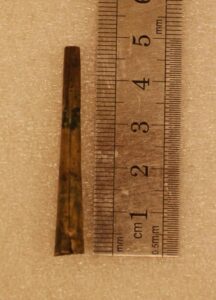
The brass is uneven in its thickness. From 0,2 mm – 0,4 mm. It is soldered (!). It bare marks of thread from the top downwards 14,4 mm. From the bottom upwards 16,4 mm.
The complete length of the staple is 47,5 mm
The top of the staple is almost not damaged at all. The opening is oval, ca 2,9 x 2,1 mm (inside). The bottom is more damaged. It has ”opened up” a bit. But still almost circular; 6,0 mm. My estimated opening of the bottom (if not damaged) is ca 5,7 mm.
It is not conical. A part of the middle is more cylindrical, and especially the bottom (the last 7 mm) is more cylindrical. If not damaged I would assume that it only would expand about 0,2 – 0,3 mm the last 7 mm.
The outside of the staple measures from the top down, with the soldered line facing up:
0 mm 3,55 mm
5 mm 4,0 mm
10 mm 4,2 mm
15 mm 4,3 mm
20 mm 4,5 mm
25 mm 4,8 mm
30 mm 5,0 mm
35 mm 5,6 mm
40 mm 6,1 mm
45 mm 6,3 mm
47,5 (estimated) 6,4 mm
47,5 (real) 6,8 mm
I attach some pictures of both the oboe and the staple.
If anyone has some questions or wants to know more please contact me:
Per Bengtsson
+46 40 263467
_per.oboe@gmail.com <mailto:per.oboe@gmail.com>_
Västra Ryttmästaregatan 25
217 52 Malmö
Sweden</mailto:per.oboe@gmail.com>
Please enjoy and spread to anyone who is interested,
Per